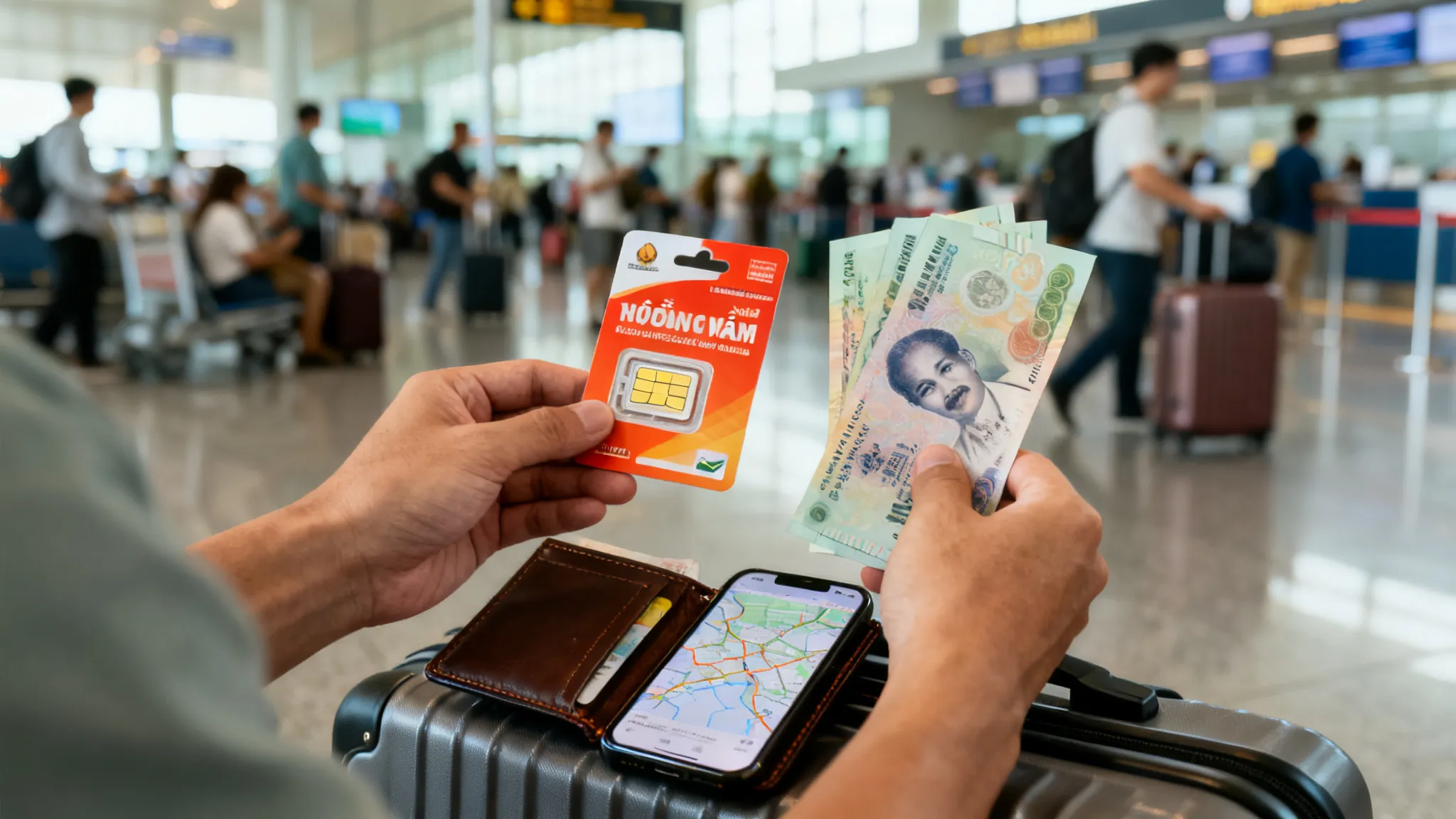
Cash, SIM Cards and Ride-Hailing After Landing in Vietnam
The first hour after landing sets the tone for your trip. Here is how to handle cash, SIM cards and ride-hailing at Vietnam's five main international airports — calmly and without overpaying.
· 5 min read
The first hour after landing can shape your whole trip. Between immigration, baggage and the wall of taxi drivers outside arrivals, it is easy to feel rushed into bad decisions. This guide walks through the three things nearly every traveller handles first — cash, a SIM card and a ride into the city — with practical steps for Vietnam's five main international airports.
Sort Out Your Priorities Before You Land
You do not need to do everything at once. A sensible order is: clear immigration, collect your bag, then deal with money, then connectivity, then transport. Trying to buy a SIM card while your suitcase is still circling the belt only adds stress.
A few things worth preparing before you fly:
- A small amount of cash in your home currency or US dollars, as a backup if the first ATM declines your card.
- A debit or credit card with international use enabled, and a rough idea of what your bank charges for foreign withdrawals.
- Your phone unlocked so it can accept a local SIM.
- The address of your hotel written down, ideally in Vietnamese, to show a driver.
If you are still sorting out entry paperwork, check the official Vietnam e-visa portal at https://evisa.gov.vn well before departure, and read our guide on Vietnam e-visa and documents to prepare before you land.
Getting Cash: ATMs and Exchange Counters
Vietnam is still a largely cash-based society for small purchases — street food, markets, short taxi hops. Cards work in hotels, malls and many restaurants, but you will want cash in your pocket on day one.
ATMs at the airport
Every one of the five international airports — Tan Son Nhat (SGN), Noi Bai (HAN), Da Nang (DAD), Cam Ranh (CXR) and Phu Quoc (PQC) — has ATMs in or near the arrivals area. A few habits keep things simple:
- Use bank-branded ATMs rather than standalone machines in shops, and prefer ones attached to a bank branch or clearly marked kiosk.
- Decline conversion offers if the machine asks whether to charge you in your home currency; choosing the local currency (VND) is usually the better default.
- Take a modest amount first, confirm the card works, then withdraw more if needed.
- Keep the receipt until you have counted the notes.
Exchange counters
Currency exchange desks are also available at all five airports. Rates at airports are rarely the best in the country, so change only what you need for the first day or two and use a bank or gold shop in the city later. If you arrive with US dollars in clean, unmarked notes, you will usually have an easy time exchanging them.
Buying a Local SIM Card
A local SIM gives you data for maps, ride-hailing and translation — arguably the single most useful purchase of your arrival. SIM counters are located in the arrivals halls at SGN, HAN, DAD, CXR and PQC.
What to expect
- Bring your passport. Registration is required for a local SIM, and staff will ask for it.
- Choose a tourist data package rather than a complicated plan; a few gigabytes for a week or two is usually enough.
- Ask staff to insert and activate the card and confirm that mobile data actually works before you walk away.
- Keep your home SIM safe in a small pouch or your wallet.
If you would rather not queue, an eSIM bought before departure is a reasonable alternative — just make sure your phone supports it and that you have data the moment you land.
Ride-Hailing: The Calm Way Out of the Airport
Ride-hailing apps have made arriving in Vietnam far less stressful than it used to be. You see the fare estimate before you commit, you pay through the app or in cash, and you avoid haggling at the kerb.
Practical steps
- Install the app and set up your account before you fly, ideally linked to a card. Some travellers find cash works fine too.
- Wait until you have your bag and a working SIM before requesting a car — drivers do not wait long.
- Use the app's designated pickup point. At larger airports this is usually a specific zone or level; follow the signs rather than walking to the general taxi rank.
- Match the licence plate and car model shown in the app before getting in.
- Keep your hotel address in Vietnamese to show the driver if the app pin lands slightly off.
At SGN and HAN in particular, arrivals halls can feel chaotic. If you are arriving late at night, our late-night arrival checklist for Ho Chi Minh City covers the details that matter after dark.
When a private transfer makes more sense
Ride-hailing is excellent for solo travellers and couples with light bags. It is less ideal when you are landing with several suitcases, travelling with elderly parents or small children, arriving on a late flight, or heading somewhere outside the city — Hoi An from Da Nang, for example, or a resort far from Nha Trang.
In those cases, a pre-booked private car with a driver waiting inside the terminal removes the guesswork. You can read how this works on our private airport transfer page, or see the specific logistics for Da Nang Airport to Hoi An and Hanoi Airport to the Old Quarter.
Where Airport Assistance Fits In
None of the above is difficult, but it all takes time and attention when you are tired. For travellers who want the arrival compressed into something calmer, a meet-and-greet service can help with the parts that are hardest to control.
At FastTrackVNS, a named assistant meets you with a name sign and guides you through formalities and baggage — with priority lanes where the airport provides them, which can make the process smoother. There is no prepayment: you pay when you meet. The service covers Tan Son Nhat (SGN), Noi Bai (HAN), Da Nang (DAD), Cam Ranh (CXR) and Phu Quoc (PQC) only, with options ranging from a simple airport meet and greet to VIP arrival and VIP departure assistance. Prices start from $35 per person, and booking at least 48 hours before your flight is recommended, with up to 20 passengers per online request. You can send a request through the booking form or by WhatsApp.
A Short Arrival Checklist
- Before flying: enable international card use, unlock your phone, save your hotel address in Vietnamese, and check https://evisa.gov.vn for entry requirements.
- On landing: clear immigration, collect your bag, then deal with money and connectivity.
- Cash: withdraw a modest amount from a bank-branded ATM and decline home-currency conversion.
- SIM: buy at an arrivals counter with your passport, and confirm data works before leaving.
- Transport: request your ride only once you are ready, use the designated pickup zone, and verify the plate.
- Heavy luggage, children, elderly parents or late arrivals: consider a pre-booked private transfer instead of ride-hailing.
Handle these three things in order — cash, SIM, then car — and the rest of your first day in Vietnam tends to take care of itself.