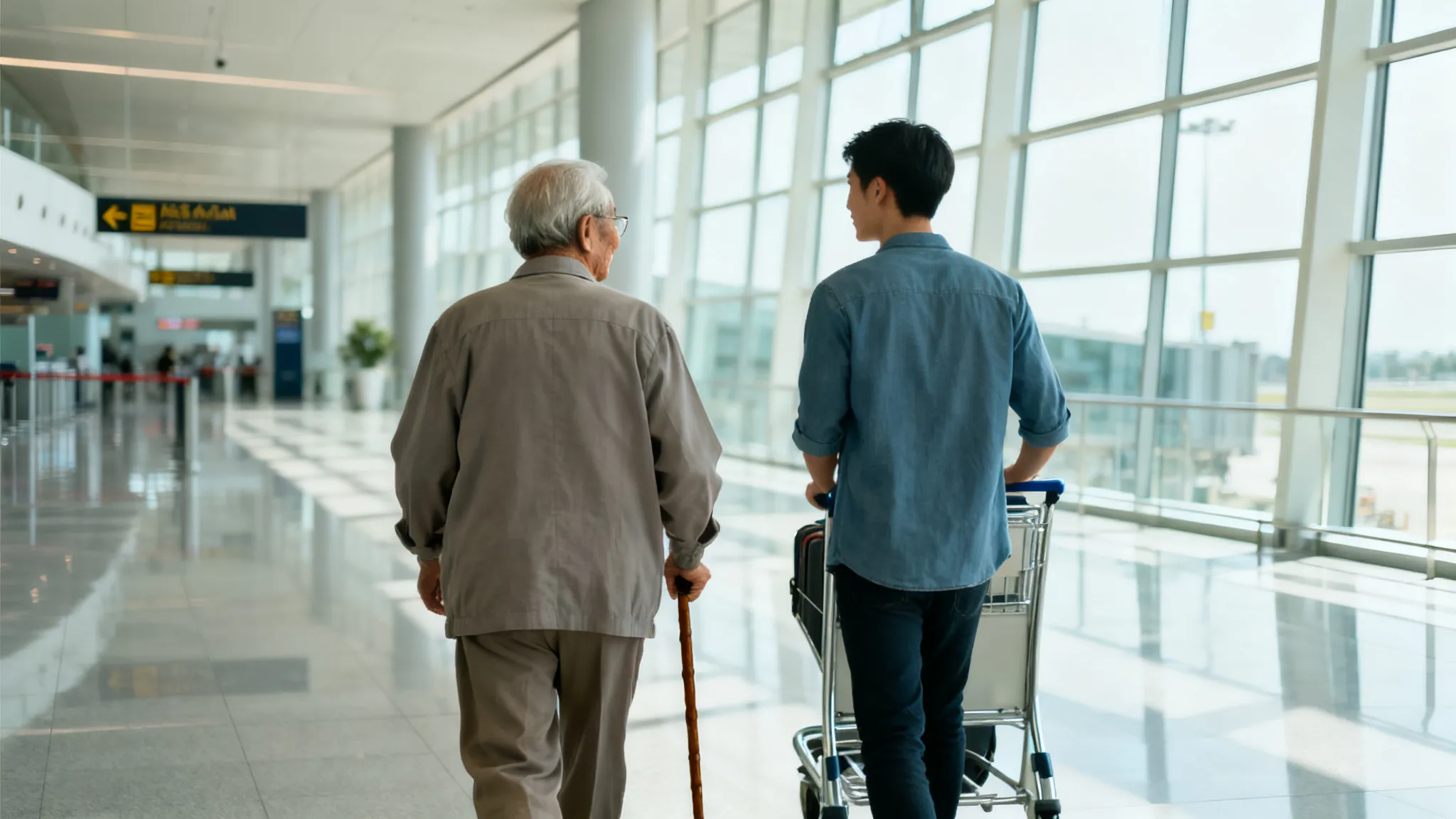
Travelling with Elderly Parents via SGN, CXR and PQC
Airports can be tiring for older travellers and anyone with reduced mobility. Here is how to plan a smoother journey through SGN, CXR and PQC, from paperwork to the car.
· 5 min read
Travelling with an elderly parent or a companion with reduced mobility asks you to plan a little differently. The flight is only part of it; the terminal itself — long walks, crowded immigration halls, waiting for bags — is often the hardest stretch. This guide looks at the three Vietnamese airports where FastTrackVNS works, Tan Son Nhat (SGN), Cam Ranh (CXR) and Phu Quoc (PQC), and how to make each one gentler for the person you are travelling with.
Start with the airline, not the airport
Before you think about terminals, sort out what the airline can do for you. Every carrier flying into Vietnam offers some form of special assistance, and it is nearly always free — but it must be requested in advance, usually when you book or at least a couple of days before departure.
- Wheelchair assistance (WCHR, WCHS, WCHC). The codes describe how far the passenger can walk and whether they can manage stairs. Ask your airline which one fits; getting this right matters more than it sounds.
- Request it both ways. Assistance on the outbound flight does not automatically apply to the return. Confirm each leg separately.
- Ask about the arrival airport too. Some airlines only guarantee assistance at the departure gate unless you confirm the destination.
- Keep the confirmation. A screenshot or printed email makes conversations at the desk much shorter.
If your parent can walk short distances but tires easily, say so. Airport staff tend to assume a wheelchair is all-or-nothing, and a passenger who can manage a few steps will have a very different experience from one who cannot.
Know what each airport asks of you
The three airports are quite different in scale, and that shapes how much walking and waiting you should expect.
Tan Son Nhat (SGN), Ho Chi Minh City
The busiest of the three and the one where crowds are most noticeable. Arrivals and departures are split across terminals, and the walk from the aircraft to immigration can be long depending on where you park. If your parent uses a wheelchair, do not assume one is waiting at the gate — that is what the airline request is for. For a step-by-step picture of the arrivals flow, see the Tan Son Nhat arrivals guide.
Cam Ranh (CXR), for Nha Trang
Smaller and generally calmer, with a straightforward single-terminal layout. The terminal itself is manageable; the longer stretch is usually the drive into Nha Trang, which is why a pre-arranged car is worth considering. Our Cam Ranh arrival guide covers the terminal side in more detail.
Phu Quoc (PQC)
A compact, modern airport that most travellers find easy to navigate. The main considerations are the heat on the apron and the transfer to your hotel. The Phu Quoc arrival guide walks through immigration and transfers.
Paperwork and the immigration hall
Immigration is where reduced mobility and tiredness combine badly. A few preparations make it much easier.
- Check visa requirements on official sources only. Rules change, and second-hand advice ages badly. Use evisa.gov.vn and confirm what applies to your parent's nationality.
- Print everything. Two copies of the e-visa or approval letter, the return ticket, hotel address and travel insurance. Phones die; paper does not.
- Keep documents in one folder your parent holds. It gives them something to do at the desk and avoids passing bags back and forth.
- Ask about priority lanes. Some airports provide priority lanes for families, older travellers and passengers with reduced mobility. Where they exist, they can make the process smoother — but they are provided by the airport, not guaranteed, and availability varies by flight and time of day.
If you would like a guide through this part of the journey, a meet and greet service can help with the formalities and baggage. For a plain explanation of how the priority process compares with the regular lane, read Fast Track vs regular immigration.
The bits people forget
- Medication in hand luggage, in original packaging, with a doctor's letter if anything is controlled. Keep it with your parent, not in the hold.
- A light layer. Airport air conditioning is fierce, and older travellers feel the cold.
- Hydration and snacks. Do not rely on finding something suitable at the right moment.
- A folding walking stick if it helps — it is usually fine through security.
- Allow more time than feels necessary. Rushing is the thing that turns a manageable journey into a miserable one.
- Book the transfer before you fly. Arriving tired and negotiating a taxi is the wrong moment to improvise. A private airport transfer with a driver waiting on arrival removes that whole conversation.
On the way home
Departures are often harder than arrivals, because everyone is tired and the check-in and security process is less forgiving of slow movement. At SGN in particular, allow generous time and ask the airline for assistance at check-in rather than at the gate. Our Tan Son Nhat departure tips cover the sequence. A VIP departure service offers a guided kerb-to-gate process if you would rather not manage it alone.
How FastTrackVNS can help
FastTrackVNS provides airport assistance at SGN, HAN, DAD, CXR and PQC. For older travellers, the most relevant options are a VIP arrival, which includes a personal welcome from the aircraft, help through immigration and baggage, and an escort out of the terminal, or the simpler meet and greet with a name-sign welcome and terminal guidance. Packages range from a Normal fast-track service to VIP B, which includes an aerobridge welcome, a private waiting area and a private passport lane where the airport provides one. Prices start from $35 per person, with no prepayment — you pay when you meet your assistant. Booking is by the online form or WhatsApp on +84964444093, ideally at least 48 hours before your flight, for up to 20 passengers per request.
A short checklist before you fly
- Request wheelchair or walking assistance with the airline, for every leg, and keep the confirmation.
- Print two copies of visa documents, tickets, hotel details and insurance.
- Pack medication and a light layer in hand luggage.
- Pre-book a private transfer so no one has to negotiate on arrival.
- Confirm which terminal you land at and share the flight number with whoever is meeting you.
- Build in buffer time at both ends, and treat priority lanes as a helpful extra rather than a promise.